Monday, September 10, 2007
Stuck
I was playing through my Tannhäuser score this afternoon, and now I can't get the Pilgrim's Chorus out of my head!

Thursday, September 6, 2007
Il maestro dorme
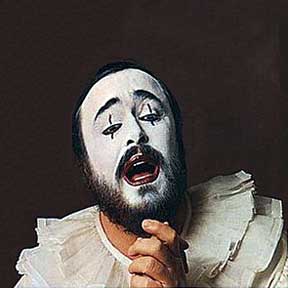
Twenty-five years ago, a fairly forgetable movie called Yes, Giorgio! played in Oklahoma City, telling the story of a opera star who loses his voice before an important concert, then falls in love with the doctor who treats him. The operaphiles—of which I was not yet one—were all excited because the main character was played by this fat Italian guy who was, apparently, one of their big opera stars.
We were just college students then, and, while we liked classical music and sang in school and church choirs, we weren't particularly well-versed in opera. Sure, there were a lot of opera melodies that were familiar tunes (thanks to Bugs Bunny and others), but we weren't exactly experts in the genre. But, off we went, and it was that night that I was first exposed to Luciano Pavarotti.
Also for the first time, I heard in that movie a little aria from a Puccini opera Turandot called "Nessun dorma"—None Shall Sleep. It was one of the songs from one of Pavarotti's standard roles as Prince Calàf, but it hadn't yet developed the "signature song" status it would get after the 1990 World Cup performance. And I liked it.
Nessun dorma! Nessun dorma! Tu pure, o Principessa, nella tua fredda stanza guardi le stelle che tremano d'amore e di speranza. Ma il mio mistero è chiuso in me, il nome mio nessun saprà! No, no, sulla tua bocca lo dirò, quando la luce splenderà! Ed il mio bacio scioglierà il silenzio che ti fa mia. Dilegua, o notte! Tramontate, stelle! Tramontate, stelle! All'alba vincerò! Vincerò! Vincerò!
None shall sleep! None shall sleep! Even you, o Princess, in your cold room, watch the stars, that tremble with love and with hope. But my secret is hidden within me, my name no one shall know. No, no, on your mouth I will tell it when the light shines. And my kiss will dissolve the silence that makes you mine! Vanish, o night! Set, stars! Set, stars! At dawn, I will win! I will win! I will win!
The performance was pretty phenomenal, and I was particularly intrigued with the ending: Pavarotti didn't sing "veen-chay-ro," but "vee-nah-chay-ro," adding a little shadow vowel syllable to his native Italian language, giving himself essentially a springboard to catapult him to that long, glorious high B that is the penultimate note of the aria. That's the way everyone sings it now.
Now that Pavarotti was on my radar screen, I started listening to his music, and marveling at his amazingly easy, pure tenor voice. There was never any struggle, never any pressure, never any pinched sound, never any heroic effort. He just floated those high notes on the air.
After that 1990 soccer game, it seems like everyone was a Pavarotti fan. In fact, it got to be next to impossible to get tickets to an opera or a concert when he was on the bill. Ticket prices skyrocketed—one Met gala had tickets as high as $1,875 each. Yet, it was worth it. As magnificent as his voice sounds on television or on a CD, there was nothing quite like hearing it live and in person.
The last time I heard Pavarotti in person was probably back in 1994 or 95 singing at the Metropolitan Opera in New York in a Verdi opera called I Lombardi. I almost didn't get to go, because the performance was long sold-out, and I wasn't able to pull any strings at the box office to get one, even at inflated prices. Fortuitously, on my flight to New York, I ran into Samuel Ramey—also en route to the Met for Lombardi, but to sing it—and bewailed my plight that I wouldn't be able to hear Sam sing because all the Pavarotti fans had bought up all the tickets. Sam said he'd take care of it, and he did: he got me a company pass that put me in the first balcony in a fabulous seat. After the long performance, I went backstage to Sam's dressing room to thank him for the ticket and get him to autograph my program. As I left, I saw this huge line going to Pavarotti's dressing room, so, even though we were only supposed to be backstage when we were on the "approved" guest lists, I decided to seize the moment, get in line, and meet il Maestro.
Once I was in the Presence, I was surprised to see how short he really is. When he is on stage, his voice and his personality made him larger than life, but that was merely an illusion. It was also so obvious that he was dying his eyebrows and beard dark, dark black, as though he wanted to avoid having to get another headshot taken, so he just changed himself to match the old photograph. He was quite patient and quite gracious as the endless fans all came to pay their respects and seek his signature. His staff had to encourage people to move along in the line and not monopolize his time. When it came time for me to greet him, he looked me up and down warily, then in his accented English said, "You sing?" I don't know how he would know to ask me that, but after my confession, he said, "Ah. Remember always to be to the music sincere."
Just a few hours ago, Pavarotti lost his battle with cancer. Today, no doubt, all the news agencies will offer retrospectives of his life and career, probably endlessly playing clips from "Nessun dorma" or "Che gelida manina." Certainly, he was the most important opera singer since Enrico Caruso, he was the modern opera superstar, he was the first cross-over musical artist, he was a leader in bringing opera to the American masses, he made "Nessun dorma" almost a household melody, he was the quintessential divo.
Calàf sings "none shall sleep," and ultimately declares that in his struggle with Princess Turandot, he will win—vincerò. Well, the cancer prevailed in this round with Pavarotti, but it didn't win. It didn't win at all, because that voice will live forever in the recordings and videos and the hearts and minds of all who heard and loved Luciano Pavarotti.
Resto nella pace, Luciano.
Thursday, August 30, 2007
Gay history makes it to the Smithsonian
In 1957, an astronomer working for the U.S. Army Map Service was fired for being homosexual. He pursed appeals and litigation to regain his job, but lost in an era when homosexuality was deemed to be "degeneracy" and something that made a person a security risk. That astronomer is Franklin Kameny, a Harvard Ph.D. and World War II Army veteran, who then launched a campaign to convince the U.S. Civil Service Commission to lift its ban on homosexuals in government service, a ban that was not lifted until 1975. In the meantime, Kameny became one of the most important gay civil rights leaders in the country, founding the Mattachine Society, an early gay activism group, and helping found the Gay Rights National Lobby, now known as the Human Rights Campaign (HRC). He was one of the leaders in lobbying the American Psychological Association to remove homosexuality as a "mental illness" and the American Bar Association in establishing legal rights for homosexuals.
Last year, Dr. Kameny, who is now in his 90s, contributed his half century's worth of files and memorabilia on the struggle for gay civil rights to the National Museum of American History at the Smithsonian Institution and to the Library of Congress.
This morning, my RSS feed picked up a story from The Advocate announcing a new exhibition from the Frank Kameny Collection on display at the Smithsonian through the end of October. So, this afternoon, I decided to wander over to the Smithsonian to see the exhibit. And, I was disappointed.
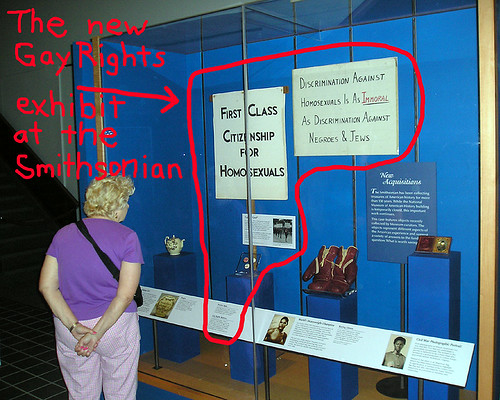
The "exhibit" consisted of just two protest posters and three buttons. But, I suppose I should be happy that there is this much on display at the Smithsonian where thousands of tourists could see the words and maybe, just maybe, give some thought to the matter.
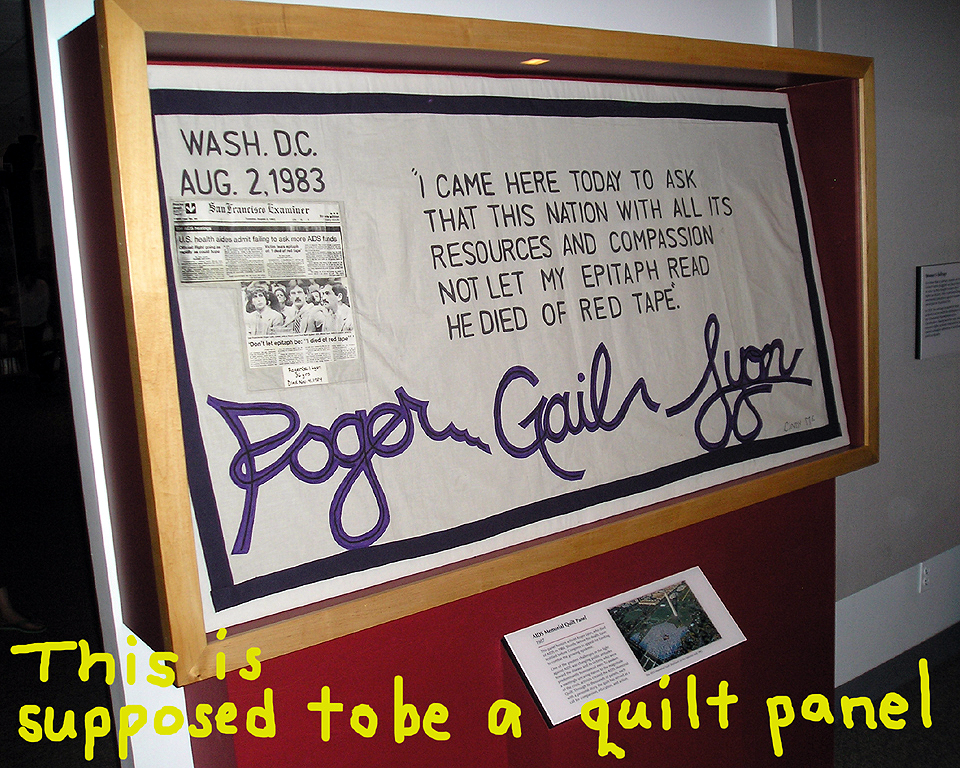 In another part of the museum, I ran across what was marked as a panel in the AIDS Memorial Quilt. Unfortunately, the display did little to convey the enormous emotional impact—or purpose—of the Quilt. I don't know how many of you have ever seen portions of the quilt, but usually when I see it, panels are laid out in a way that entirely covers the floor of a gymnasium or convention center. Each panel was made by the family and friends of a victim of HIV, and offers a memorial to that person and his (or her) life and interests.
While at the museum, I had to visit the men's room. Interestingly, I was very self-conscious as to how wide my feet were apart in the stall, and then when someone came in and sat in the next stall, I became very concerned about not moving my toes—I'd changed into a pair of Birkenstocks before going to the museum, so they were very visible. Odd how current events have an impact on us, even in a museum with an exhibit on gay rights.
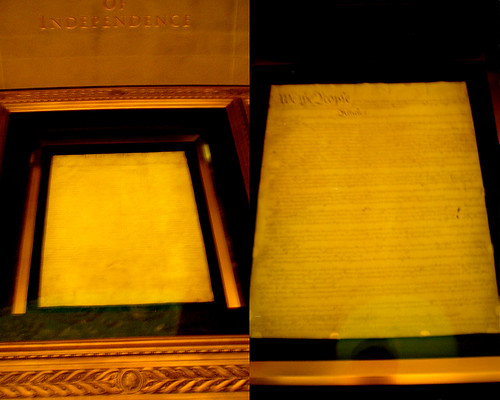
While I was in the neighborhood, I thought it would be comforting to visit a certain exhibit of those fundamental documents that provide our civil rights in this country, the Declaration of Independence and the Constitution of the United States, on display in very carefully constructed and controlled cases at the National Archives. They are getting very faded these days, especially the Declaration, but we all still know what they say and we have plenty of reproductions around. Nevertheless, it's always good to see the real thing.
Last year, Dr. Kameny, who is now in his 90s, contributed his half century's worth of files and memorabilia on the struggle for gay civil rights to the National Museum of American History at the Smithsonian Institution and to the Library of Congress.
This morning, my RSS feed picked up a story from The Advocate announcing a new exhibition from the Frank Kameny Collection on display at the Smithsonian through the end of October. So, this afternoon, I decided to wander over to the Smithsonian to see the exhibit. And, I was disappointed.
The "exhibit" consisted of just two protest posters and three buttons. But, I suppose I should be happy that there is this much on display at the Smithsonian where thousands of tourists could see the words and maybe, just maybe, give some thought to the matter.
In another part of the museum, I ran across what was marked as a panel in the AIDS Memorial Quilt. Unfortunately, the display did little to convey the enormous emotional impact—or purpose—of the Quilt. I don't know how many of you have ever seen portions of the quilt, but usually when I see it, panels are laid out in a way that entirely covers the floor of a gymnasium or convention center. Each panel was made by the family and friends of a victim of HIV, and offers a memorial to that person and his (or her) life and interests.While at the museum, I had to visit the men's room. Interestingly, I was very self-conscious as to how wide my feet were apart in the stall, and then when someone came in and sat in the next stall, I became very concerned about not moving my toes—I'd changed into a pair of Birkenstocks before going to the museum, so they were very visible. Odd how current events have an impact on us, even in a museum with an exhibit on gay rights.
While I was in the neighborhood, I thought it would be comforting to visit a certain exhibit of those fundamental documents that provide our civil rights in this country, the Declaration of Independence and the Constitution of the United States, on display in very carefully constructed and controlled cases at the National Archives. They are getting very faded these days, especially the Declaration, but we all still know what they say and we have plenty of reproductions around. Nevertheless, it's always good to see the real thing.
Sunday, August 26, 2007
Oh, thank God, it's the Mormons!
Nearly fifty years ago, many in the country were asking whether or not John Kennedy could be trusted to be president of the United States because he was a Roman Catholic, and he might be subject to taking orders from the pope. This morning as I was sitting in St. Stephen's—a place where the Kennedy family often worshipped—I started thinking about that and the parallels of the current dilemma we have in the Republican Party with the upcoming 2008 presidential election.
What triggered this line of thinking is the fact that Friday night, we went to see the new movie September Dawn, the true story of how the Mormons in Utah slaughtered a group of 120 Arkansas pioneers on their way to California in 1857, and the "conspiracy theory" that orders for the massacre came from the highest levels of the Mormon Church, even from then-president Brigham Young himself.
Now, September Dawn purely as a movie wasn't really the best-made movie I've ever seen. Aside from some fine performances from Jon Voight as Bishop Samuelson and Terence Stamp as Brigham Young, the rest of the cast (mostly because of the script and direction) bounced between stilted and high school drama club. The movie was based on the few available details of the factual massacre, and the script writers took a great deal of artistic license to create a very predictable love story that dominated most of the movie, I guess to balance out the hard facts of church history, conspiring with the Indians, and killing men, women, and children. The editing is choppy, camera angles monotonous, and it was several minutes into the film and its jumping around from date to date that I finally figured out what was going on.
The one thing the movie did drive home, though, was the strong, controlling, dominating influence of religious fundamentalist fanasticism and what such zealots can do "in the name of God." Now, the Mormons certainly have no monopoly on fanaticism and murdering in the name of God. After all, the Catholics have been doing that for millennia (remember the Crusades? the Inquisition?), and the Protestants have continued it themselves for centuries (reformation wars, witch hunts, etc.). We're also seeing a lot of it these days with modern Muslims.
Fifty years ago, though, I would venture to say that most Catholics would be quick to question an order from the pope or some archbishop to go murder innocent people, and today in 2007, Catholics not only would question but would "tell them where to go." The papal control thing was never really a serious concern in 1960 with John Kennedy.
The Mormons, though, are completely another matter. Now, as a non-Mormon, I may not have all the details just right, but I think I understand the gist of things. I might also say that I have a number of friends and acquaintances who are Mormons, and I respect the family-centered commitment and uprightness of their church and membership, so I have no ax to grind against them. The Mormons have a president they believe is God's prophet on earth, and a high council of a dozen or so "apostles" they believe are also in direct communication with God. The Mormon Church is extremely hierarchical, with small, local groups being ruled by lay bishops who have pretty much absolute authority over the members of their wards. I know Mormons who have quit their jobs and moved to different towns to fulfill the orders of their bishop or higher church authorities, and others who have taken on volunteer positions or tasks even when they didn't really have time for them. Discipline and obedience are very highly prized standards in the Mormon Church. Certainly, they aren't the zealots they were in the mid-19th century and they don't go around killing their errant members anymore, but the rules and pressure for obedience are still there. And, thus, we have the source for the Republican's current dilemma: Mitt Romney.
If Governor Romney were to become President of the United States, if the highest councils of the Mormon Church were to tell him to do a particular thing, what would he do? Now, of course, Mr. Romney is going to say that he will fulfill his oath of office to the Constitution and to the People, and that will override anything the Mormon Church might want. Yet, what will really happen? I believe that even today, Mormons are acculturated to do what the church leadership tells them to do. If push comes to shove, my gut feeling is that Mr. Romney is going to do what his church tells him to do.
What is particularly interesting about the September Dawn movie is Governor Romney's ancestor's role in the massacre. His Mormon polygamist great-great-grandfather "stole" an Arkansas woman to make her one of his wives, but the woman's husband didn't take kindly to that, and killed the Romney progenitor. It is believed that revenge and "blood atonement" for his death was one of the primary motivators for the Utah massacre of the Arkansans. I hear that Governor Romney does not plan to see September Dawn.
There are many who are claiming that this movie was made solely for the purpose of embarrassing the Mormons and hindering Governor Romney's presidential campaign. I give that argument short shrift. The massacre is historical fact. Look at the date of the massacre, too: September 11, 1857. This is the sesquicentennial (a/k/a 150th anniversary) of the massacre. I hardly think that the Governor's detractors began planning this 150 years ago.
September Dawn isn't going to win any Academy Awards. It is a useful vehicle, though, to educate us about a sad chapter of American history and to remind us of the rules and traditions of a major religious organization in America. I don't believe the movie's purpose is to foment anti-Mormon sentiment or embarrass Romney any more than a movie about the 1507 historical incident when 30 "witches" were burned by the Spanish Inquisition would be anything more than a 500th anniversary observance of the event, and certainly not a movie attempting to drum up anti-Catholicism or embarrass the presidential campaign of Rudy Guiliani.
So, I take the movie on its face value. Release is pretty limited (it's only at one theater in all of Washington, D.C.!), so if its showing near you, consider seeing it, especially if you are unfamiliar with the Mormon Church. And, if you can't catch it this month, at least try to rent the DVD.
(By the way, the title of the post is a quote from the movie, when the Arkansans have been under siege and the Mormons show up to "help" them shortly before murdering all of them.)
What triggered this line of thinking is the fact that Friday night, we went to see the new movie September Dawn, the true story of how the Mormons in Utah slaughtered a group of 120 Arkansas pioneers on their way to California in 1857, and the "conspiracy theory" that orders for the massacre came from the highest levels of the Mormon Church, even from then-president Brigham Young himself.
Now, September Dawn purely as a movie wasn't really the best-made movie I've ever seen. Aside from some fine performances from Jon Voight as Bishop Samuelson and Terence Stamp as Brigham Young, the rest of the cast (mostly because of the script and direction) bounced between stilted and high school drama club. The movie was based on the few available details of the factual massacre, and the script writers took a great deal of artistic license to create a very predictable love story that dominated most of the movie, I guess to balance out the hard facts of church history, conspiring with the Indians, and killing men, women, and children. The editing is choppy, camera angles monotonous, and it was several minutes into the film and its jumping around from date to date that I finally figured out what was going on.
The one thing the movie did drive home, though, was the strong, controlling, dominating influence of religious fundamentalist fanasticism and what such zealots can do "in the name of God." Now, the Mormons certainly have no monopoly on fanaticism and murdering in the name of God. After all, the Catholics have been doing that for millennia (remember the Crusades? the Inquisition?), and the Protestants have continued it themselves for centuries (reformation wars, witch hunts, etc.). We're also seeing a lot of it these days with modern Muslims.
Fifty years ago, though, I would venture to say that most Catholics would be quick to question an order from the pope or some archbishop to go murder innocent people, and today in 2007, Catholics not only would question but would "tell them where to go." The papal control thing was never really a serious concern in 1960 with John Kennedy.
The Mormons, though, are completely another matter. Now, as a non-Mormon, I may not have all the details just right, but I think I understand the gist of things. I might also say that I have a number of friends and acquaintances who are Mormons, and I respect the family-centered commitment and uprightness of their church and membership, so I have no ax to grind against them. The Mormons have a president they believe is God's prophet on earth, and a high council of a dozen or so "apostles" they believe are also in direct communication with God. The Mormon Church is extremely hierarchical, with small, local groups being ruled by lay bishops who have pretty much absolute authority over the members of their wards. I know Mormons who have quit their jobs and moved to different towns to fulfill the orders of their bishop or higher church authorities, and others who have taken on volunteer positions or tasks even when they didn't really have time for them. Discipline and obedience are very highly prized standards in the Mormon Church. Certainly, they aren't the zealots they were in the mid-19th century and they don't go around killing their errant members anymore, but the rules and pressure for obedience are still there. And, thus, we have the source for the Republican's current dilemma: Mitt Romney.
If Governor Romney were to become President of the United States, if the highest councils of the Mormon Church were to tell him to do a particular thing, what would he do? Now, of course, Mr. Romney is going to say that he will fulfill his oath of office to the Constitution and to the People, and that will override anything the Mormon Church might want. Yet, what will really happen? I believe that even today, Mormons are acculturated to do what the church leadership tells them to do. If push comes to shove, my gut feeling is that Mr. Romney is going to do what his church tells him to do.
What is particularly interesting about the September Dawn movie is Governor Romney's ancestor's role in the massacre. His Mormon polygamist great-great-grandfather "stole" an Arkansas woman to make her one of his wives, but the woman's husband didn't take kindly to that, and killed the Romney progenitor. It is believed that revenge and "blood atonement" for his death was one of the primary motivators for the Utah massacre of the Arkansans. I hear that Governor Romney does not plan to see September Dawn.
There are many who are claiming that this movie was made solely for the purpose of embarrassing the Mormons and hindering Governor Romney's presidential campaign. I give that argument short shrift. The massacre is historical fact. Look at the date of the massacre, too: September 11, 1857. This is the sesquicentennial (a/k/a 150th anniversary) of the massacre. I hardly think that the Governor's detractors began planning this 150 years ago.
September Dawn isn't going to win any Academy Awards. It is a useful vehicle, though, to educate us about a sad chapter of American history and to remind us of the rules and traditions of a major religious organization in America. I don't believe the movie's purpose is to foment anti-Mormon sentiment or embarrass Romney any more than a movie about the 1507 historical incident when 30 "witches" were burned by the Spanish Inquisition would be anything more than a 500th anniversary observance of the event, and certainly not a movie attempting to drum up anti-Catholicism or embarrass the presidential campaign of Rudy Guiliani.
So, I take the movie on its face value. Release is pretty limited (it's only at one theater in all of Washington, D.C.!), so if its showing near you, consider seeing it, especially if you are unfamiliar with the Mormon Church. And, if you can't catch it this month, at least try to rent the DVD.
(By the way, the title of the post is a quote from the movie, when the Arkansans have been under siege and the Mormons show up to "help" them shortly before murdering all of them.)
Monday, August 13, 2007
Indian collections
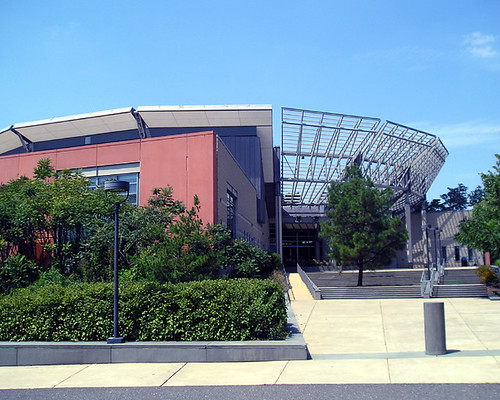
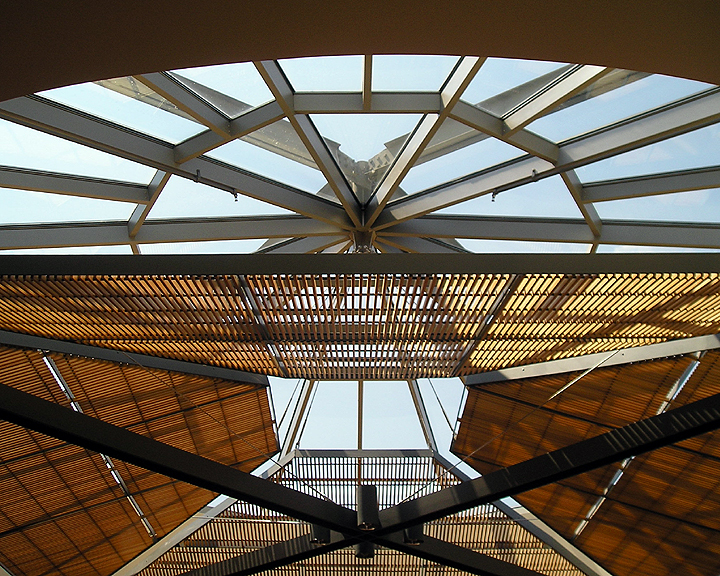 Over 800,000 artifacts and items of everyday use are housed in a state of the art research facility in Suitland, Maryland, for the National Museum of the American Indian at its Cultural Resources Center. The Center is the home for the things on exhibit at the museum in Washington, as well as its Indian museum in the Old Customs House in New York City, plus items on loan to museums around the world.
The building itself is quite striking. Much like the museum in the District, it has been designed with Indian sensibilities in mind and echos traditional Indian architecture. While there is an impressive entry foyer, this is not really a building designed for tourists and visitors. It's a working facility for museum curators and staffers, plus armies of archivists, librarians, and conservation specialists. They do occasionally have visitors from other museums seeking materials for an exhibit and the occasional graduate student or researcher, so there are a few rooms to accommodate their needs.
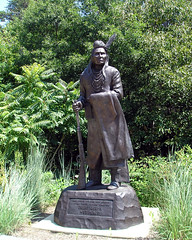
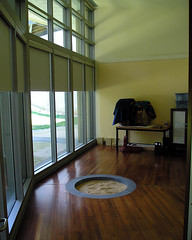
The grounds are also landscaped in an "Indian" way. A large bronze statue of the famous Nez Perce leader Chief Joseph stands near the entrance. They have a small ceremonial circle in the woods behind the building, and a small room inside the building serves as a ceremonial room complete with sand fire pit in the floor.
 |  |
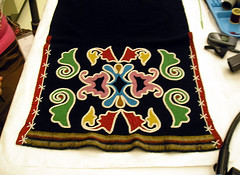 Conservation, repair, and preservation occupies a great deal of the center. They do things like put the pieces of old, shattered pottery back together, replace beads and porcupine quills on decorative pieces, and clean archeological finds. While I was in the textiles room, conservators were cleaning this beautiful Sac and Fox men's breechcloth with tweezers and a low-suction vacuum. It's made of navy blue wool broadcloth, edged with silk ribbon, and decorated with beads sewn on one at a time. The other end of the breechcloth has a similar beaded panel. The Sac and Fox, much like my tribe, makes use of a lot of abstract floral designs in their beadwork. I'm going to guess this piece comes from the Sac and Fox up in far northeastern Kansas (rather than the group in central Oklahoma for whom I used to be a supreme court justice) because they are making use of beads in that dusty rose color that is very, very popular with the Crow, a tribe in the northern plains.
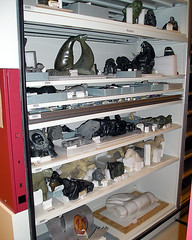 All of the archivists were on hand today to show off their shelves and shelves of items, and they were all very helpful and friendly. Now, this picture is of a rack of stone carvings done by Indians/Inuits/Eskimos from the Arctic regions, and they all have a very distinctive style to them. While talking to the staff member working the Arctic shelves, we got to talking about the clothing items they had in the racks and whether or not they required any special "cold" climate control to prevent deterioration. He said they tried to keep some of the things cooler and less humid than other things in the overall collections because a lot of the leather items had been tanned with urine!
These storage cabinets are all on rollers so the entire row of units can be moved flush side-to-side to save space between aisles. If one wants to see something in the middle of a group of rows, one has to wait until people are done elsewhere and the aisles are clear so everything can be moved to open up a new aisle where one wishes to work. They also go up probably twenty feet high, so there was a lot I couldn't see or get to without an appointment and a ladder.
I took several dozen pictures of various things, especially Great Lakes region tribes' beadwork and ribbonwork, plus some Seminole items. If you'd like to see them, click here to go to my Flickr album.
Monday, July 30, 2007
Late night ramblings
Well, I should be in bed, but I'm totally not sleepy.
Yesterday (Saturday) night, Ryan made me go with him and Robert to see The Simpsons Movie, even though I didn't want to go out. They seemed to have had an extra ticket and they didn't want to waste it (at $10.25 each!). Robert bought this absolutely enormous bucket of popcorn, but by the end of the movie, he and Ryan had only eaten maybe as much of a fourth of it.
The movie was funny and entertaining, though it had several questionable "PG-13" moments. There's a scene where Homer dares his son, Bart, to skateboard downtown and back naked (including a pedophilic moment displaying the boy's cartoon genitalia), and one where Marge interrupts Homer in what was implied to be a possible moment of beastiality. There is another scene where Homer is cared for by a buxom Indian medicine woman and the movie engages in a somewhat racist making fun of Indian culture and vision quests.
The movie did have some interesting explorations, including examination of Homer and Marge's marriage and the relationship between Homer and Bart. Lisa, meanwhile, was somewhat sidelined in this show, though she does get a mysterious, new boyfriend. Some of the humor in the show is very topical; it's really funny today in July 2007, but in five or ten years, will anybody get the joke? A few things are very esoteric—I caught a couple of things my compadres apparently missed. This is definitely a movie that will require multiple viewings for full appreciation.
Today (Sunday) has been rather an uneventful day. It rained much of the afternoon, so I spent a bunch of time trying to learn the accompaniment to Haydn's The Creation. I'm too out of practice; my fingers keep getting tangled up on all those runs of parallel thirds.
Yesterday (Saturday) night, Ryan made me go with him and Robert to see The Simpsons Movie, even though I didn't want to go out. They seemed to have had an extra ticket and they didn't want to waste it (at $10.25 each!). Robert bought this absolutely enormous bucket of popcorn, but by the end of the movie, he and Ryan had only eaten maybe as much of a fourth of it.
The movie was funny and entertaining, though it had several questionable "PG-13" moments. There's a scene where Homer dares his son, Bart, to skateboard downtown and back naked (including a pedophilic moment displaying the boy's cartoon genitalia), and one where Marge interrupts Homer in what was implied to be a possible moment of beastiality. There is another scene where Homer is cared for by a buxom Indian medicine woman and the movie engages in a somewhat racist making fun of Indian culture and vision quests.
The movie did have some interesting explorations, including examination of Homer and Marge's marriage and the relationship between Homer and Bart. Lisa, meanwhile, was somewhat sidelined in this show, though she does get a mysterious, new boyfriend. Some of the humor in the show is very topical; it's really funny today in July 2007, but in five or ten years, will anybody get the joke? A few things are very esoteric—I caught a couple of things my compadres apparently missed. This is definitely a movie that will require multiple viewings for full appreciation.
Today (Sunday) has been rather an uneventful day. It rained much of the afternoon, so I spent a bunch of time trying to learn the accompaniment to Haydn's The Creation. I'm too out of practice; my fingers keep getting tangled up on all those runs of parallel thirds.
Thursday, June 21, 2007
The bare essentials
Tonight in honor of Ryan's birthday on the morrow, Robert bought us all tickets to the Washington Shakespeare Company's production of Macbeth. WSC is the "other" Shakespeare company in D.C., not to be confused with the renowned Shakespeare Theater Company that has the big theater venues in downtown D.C. WSC is a sort of small, experimental company with a playhouse in a seedy warehouse district in Arlington.
This production of Macbeth has garnered national attention for WSC because the director chose to costume the entire cast in the nude. The nudity supposedly isn't a publicity stunt, but the director's vision to pare the play down to the bare essentials and expose the primal nature of the characters.
My thought? Eh. I didn't think the nudity did much one way or the other. It certainly did save them a lot of money on costuming, though. All they did was put some green and brown makeup splotches on the actors.
This was all quite a new experience for me, though. This is the first time I've ever watched naked females move around in person. Sure, I've seen photographs and movies, but never before, live and in person, without the benefit of airbrushing and makeup. These women (except for the one Asian woman) were all very rubenesque, while all of the men (except for one older character) were really skinny.
The thing I found most difficult with this particular production was the cast size. There are about 27 different characters in the play. WSC's cast had only six men and four women, so everyone except Macbeth had multiple roles. It was confusing. Now, this is not the first time I've seen Macbeth (duh), but I still had problems keeping track of who was who and when. Compounding the problem was their decision to have some of the women in the cast play male characters. I think in this case, the nudity worked against them, since the audience couldn't identify characters by their costumes and when a woman was playing a man, it was very obvious they weren't male. Of course, the director didn't want the actors hiding behind their costumes, so I don't know what else they could have done.
The theater itself is a "black box" theater with about 100 steeply banked seats. The stage for this show is a flat, right triangle platform with the audience setting along the hypotenuse. Nine very tall, very thin primitive looking statues of men and women stood behind the stage in the corners, recalling both the statues on Easter Island and "trees." Down stage left they have a hole in the stage to contain a deep pool of water that also doubled as the witches' cauldron. They added a smoke "haze" around the stage which, of course, meant there was haze throughout the theater.
The three best actors were the three witches. Aside from the fact that they spoke so loudly their voices reverberated in the theater, they provided the dramatic focal point and commentary for the whole play. The actor playing Macbeth was a favorite of Ryan and Robert (I don't think either of them were paying attention to his acting), but I was unimpressed, finding his emotional range rather limited as about all he did was yell and scream all the time. Lady Macbeth/Hecate was interestingly "contemporary" in her delivery, which, at times, I found mildly disconcerting. All of the other actors performed serviceably, though with all, there were moments I was not able to understand their words, and sometimes the stage movements of the men were a bit stilted and looked like "acting." Plus, with all of the male actors other than Banquo, I never bought their characters as Scottish nobility and war lords (not that they were effeminate, but they just didn't have that kind of hypermasculinity).
Tonight was the closing night of the run, which has been going on for about a month, so, you can't go see this play now if you missed it. Their next big production this fall will be Caligula.
And thus was our evening. What did you do tonight?
This production of Macbeth has garnered national attention for WSC because the director chose to costume the entire cast in the nude. The nudity supposedly isn't a publicity stunt, but the director's vision to pare the play down to the bare essentials and expose the primal nature of the characters.
My thought? Eh. I didn't think the nudity did much one way or the other. It certainly did save them a lot of money on costuming, though. All they did was put some green and brown makeup splotches on the actors.
This was all quite a new experience for me, though. This is the first time I've ever watched naked females move around in person. Sure, I've seen photographs and movies, but never before, live and in person, without the benefit of airbrushing and makeup. These women (except for the one Asian woman) were all very rubenesque, while all of the men (except for one older character) were really skinny.
The thing I found most difficult with this particular production was the cast size. There are about 27 different characters in the play. WSC's cast had only six men and four women, so everyone except Macbeth had multiple roles. It was confusing. Now, this is not the first time I've seen Macbeth (duh), but I still had problems keeping track of who was who and when. Compounding the problem was their decision to have some of the women in the cast play male characters. I think in this case, the nudity worked against them, since the audience couldn't identify characters by their costumes and when a woman was playing a man, it was very obvious they weren't male. Of course, the director didn't want the actors hiding behind their costumes, so I don't know what else they could have done.
The theater itself is a "black box" theater with about 100 steeply banked seats. The stage for this show is a flat, right triangle platform with the audience setting along the hypotenuse. Nine very tall, very thin primitive looking statues of men and women stood behind the stage in the corners, recalling both the statues on Easter Island and "trees." Down stage left they have a hole in the stage to contain a deep pool of water that also doubled as the witches' cauldron. They added a smoke "haze" around the stage which, of course, meant there was haze throughout the theater.
The three best actors were the three witches. Aside from the fact that they spoke so loudly their voices reverberated in the theater, they provided the dramatic focal point and commentary for the whole play. The actor playing Macbeth was a favorite of Ryan and Robert (I don't think either of them were paying attention to his acting), but I was unimpressed, finding his emotional range rather limited as about all he did was yell and scream all the time. Lady Macbeth/Hecate was interestingly "contemporary" in her delivery, which, at times, I found mildly disconcerting. All of the other actors performed serviceably, though with all, there were moments I was not able to understand their words, and sometimes the stage movements of the men were a bit stilted and looked like "acting." Plus, with all of the male actors other than Banquo, I never bought their characters as Scottish nobility and war lords (not that they were effeminate, but they just didn't have that kind of hypermasculinity).
Tonight was the closing night of the run, which has been going on for about a month, so, you can't go see this play now if you missed it. Their next big production this fall will be Caligula.
And thus was our evening. What did you do tonight?
Subscribe to:
Posts (Atom)
