I'm going to the opera (A View from the Bridge) at the Kennedy Center tonight all by myself. Is anybody else going? I'd love to get together for a cocktail or something at the intermission. My ticket is H 12, orchestra right. Lemme know!
I'm really excited to be going to Washington National Opera tonight. Their tickets are so dreadfully expensive (orchestra seats can be as much as $220 for a non-gala performance!), that I seldom go unless I know people in the cast, or the opera is unusual or a new work, as is the case tonight.
This particular new opera is based on the play by Arthur Miller. Miller, who was formerly married to Marilyn Monroe, also wrote the play, The Crucible, and I've previously sung the opera (music by Robert Ward) based on it. The music tonight is by a guy called William Bolcom, who is a pianist and composer on faculty at the University of Michigan. He received the commission for this work from Lyric Opera of Chicago, where it premiered in 1999 to great critical and popular acclaim. While he's written a lot of stuff, I don't recall ever having heard any of it before, and Bridge is his most famous oeuvre. So, it should be a very, very interesting evening.
Wednesday, November 14, 2007

Saturday, November 3, 2007
All Beethoven, all the time

The National Symphony Orchestra is playing an all-Beethoven concert this weekend in their classics series, featuring the young violinist Nikolaj Znaider as soloist. Our little gang went last night. I never get tickets in the same spot in the house, so this time we all sat on the very first row right in front of the first violins. This ended up being quite the interesting place to sit and watch, especially to observe principal guest conductor (who becomes the principal conductor next fall) Iván Fischer on the podium, and we were perfectly positioned to see the violinist's fingering and hear his fingers thumping on his instrument.
The highlight of the evening was the famous Symphony No. 5 in C minor, Op. 67, the one with the "da da da dahhhhhhh" opening motif. Maestro Fischer took the first movement at a frightening brisk tempo, then in the final movement he was again so fast I remember thinking to myself how I was glad I wasn't having to try to play a piano reduction! In the first movement, the horns were right on the mark and in the whole symphony, the cellos got quite the workout. The audience rewarded the symphony (and the end of the concert) with a standing ovation and three curtain calls.
The first half featured Znaider in the Concerto in D Major for Violin and Orchestra, Op. 61, and he was well received by the audience. He played passionately, sometimes almost violently on his 1704 Stradivarius. I was in just the right position in the house that, when Znaider was turning to watch the concertmistress at key times, he started looking right at me! For those of you who've never performed on a large stage, the lights blazing on the stage generally make all but the first two rows or so of the house a big, black hole. Some performers need the feedback and support of their audience, so they play/sing to some of the people they can actually see, and I guess I got picked for that task last night.
Znaider is a handsome thirty-year-old who is tall with an athletic build and a shock of curly, brown hair. He chose to wear, however, some sort of hideous European-styled black frock coat with four buttoned buttons, no lapels (they were so obviously missing they almost looked cut away), and a turned up collar that looked way too small for him (but that is the current "modern" European fashion), paired with a white, wide-banded collar shirt worn open at the neck. The coat had a bright red lining and he sported a matching red pocket square; his cuffs were fastened with gold square cufflinks bordered with black onyx.
Each half of the concert opened with an overture, first the one to Egmont, Op. 84, and second the one to Coriolan, Op. 62.
Earlier I mentioned watching Mo. FIscher conduct. It was actually both surprising and entertaining. He's a very active and dynamic conductor, but what most caught my attention was the degree of noise he makes. He made all kinds of breathing and whooshing sounds, even growling a couple of times, to help him punctuate his direction. And, he managed to get a pretty good sound out of the orchestra, though there were at least three times when I heard unexpected wrong notes pop up from somewhere in the orchestra.
I was pleased to note that Mo. Fischer was properly attired in white tie and tails, unlike Mo. Leonard Slatkin, who never seems to dress correctly. Being on the first row also gave me a chance to look in detail at the orchestra members, and I noted an interesting thing: the men who wore wing-collar shirts (the proper shirt for white tie) also wore black patent leather shoes (the proper shoes for a tail coat), while men in regular pointed collars wore more casual black leather shoes.
Twas a lovely evening with a packed house and music that was 200 years old, yet refreshing and inspirational to us all.
Saturday, October 20, 2007
Piano soundings
 It's like we've gotten a new conductor in Washington.
Two weeks in a row now, I've been to a National Symphony Orchestra concert at the Kennedy Center with NSO's music director Leonard Slatkin on the podium, and the orchestra has been brilliant, the conducting inspired, and the entire ensemble of players and conductor have been together and have been right on the money with one another. This is the famous Slatkin who put the Saint Louis Symphony "on the map" in the 1980s and '90s, and who came to Washington with such excitement and high expectations a dozen years ago. I've missed "that" Slatkin the past few years in D.C., but, wow! he's back now in his final season at NSO before he goes off to Detroit as music director and Pittsburgh as principal guest conductor.
If you want to hear him with the NSO, you have to wait until after Christmas now, as he's not scheduled again to conduct until January, but do make a point to come hear him if you can.
Last night, Jon, Ryan, and I went to hear the NSO and famed piano soloist Emanuel Ax. Twas a lovely performance.
NSO saved Ax for the second half of the concert. He lumbered out on stage as if playing the Brahms Piano Concerto No. 2 in B-flat Major with a major international orchestra were the simplest, most lackadaisical thing in the world to be doing. Then, rather than showboating to the audience, he played to the orchestra, nodding at players, watching them play, and occasionally keeping time with a shake of his jowls. When it was time for him to play, he loomed over the keyboard, his arms spread wide and his elbows always out more than I would find comfortable. The keys were his, though, and he hoarded them, making them sing the way of his choosing.
The Brahms has been a well-known part of the piano repertoire for over a century, and Ax did a fine interpretation. The first two movements are both fast allegros, rather massive, and quite typical of a major piano concerto.
One of the gems of this concerto, though, is the third movement "Andante," where the cello joins in as a major player, almost as if this piece were a double concerto. The cello duties fell to NSO principal cellist David Hardy, who played his 1694 Carlo Testore instrument exquisitely. Hardy is actually a Baltimore native who studied at the Peabody Conservatory there, and right out of college he was appointed associate principal cellist by NSO's late music director Mstislav Rostropovich, himself an internationally reknowned cellist. That should certainly say something about Hardy and his abilities! Today, Hardy has been principal since 1994, having spent practically his entire career at NSO; he's a tall, slender man with immaculately groomed silver hair, rimless glasses, and a very upright, formal air about him. He seemed almost embarrassed during the curtain calls as Ax repeated brought him forward for a bow.
The final movement of the concerto is an allegretto, a suitably playful bit that matched well Ax's whimsy in playing. The audience awarded Ax some four curtain calls after the performance.
The first half of the concert was as though the music were from two totally different worlds. Starting with American William Schuman's "Prayer in Time of War," then ending with Englishman Ralph Vaughn-Williams' Symphony No. 6 in E minor, both of these post-World War II works were loud and brassy at times, yet both conveying sorrow and introspection. This is also a pair of pieces that helps to clearly demonstrate the major difference between sitting at home listening to a CD or MP3 of orchestral works and hearing them live and in person in a concert hall. One very simply cannot use electronic recordings and the compression necessary to transmit them and appreciate the full dynamic range and emotion of these works, from very very loud portions to the very very soft.
Schuman is one of those "modern" composers who can at times be rather trying. I liked this work, though, and I thought it was quite approachable. I was previously unfamiliar with it, but it's a good bit, and I hope someone records it so it can be heard by more people.
Before last night, I never appreciated the Vaughn-Williams Sixth. This is largely because of having to hear it in recorded form, and there's just absolutely no way to appreciate this music—especially the last movement "Epilogue"—without sitting in a concert hall. This was a particularly good reading, too, with Slatkin and NSO in synch together, Slatkin even at times jumping around and almost dancing on the podium.
Many people are familiar with Vaughn-Williams because of his church hymns—"standards" like Sine Nomine (For all the saints), Salve festa dies (Hail thee, festival day), King's Weston (At the Name of Jesus every knee shall bow), Down Ampney (Come down, O Love divine)—but his orchestral music is very, very different. This particular symphony is shockingly modern for those used to Vaughn-Williams' melodic hymns, as it's rather bombastic at times, almost jazzy at others, and even makes rather odd use of a saxophone. It's also played as one continuous bit with no break between movements.
What enthralled me about the Sixth, though, was what I'd never been able to appreciate on a recording: the Epilogue. The entire movement is played with the loudest dynamic a pianissimo, and much of the orchestra work was even softer than that at times. This made the audience have to sit forward in their seats, nearly straining to listen, nearly holding their breaths to hear. There was no big ending, no bombastic explosion of virtuosity, just the sad, soft, undulating tunes, like a lost child wandering aimlessly in the night.
Yet, even with the quiet and uncertain ending of the work, the symphony moved the audience to award two curtain calls.
Definitely, this was a memorable musical experience.
I moved our seats up a bit for this concert, since I wanted to be able to see the piano and the keyboard. The Kennedy Center Concert Hall has a rather unique seating arrangement on the orchestra level. If one were to draw a long tic-tac-toe grid, that's pretty much how the floor plan looks (not counting the four levels of horseshoe boxes and balconies). For orchestral music, I usually sit towards the back of the hall in the upper center section of the "grid" for the best sound blend; last night, we were in the center square, a section the orchestra management considers to be the "orchestra prime" section. I really don't know why. A few rows back or even forward to the top or bottom center grid sections, or across the aisles to the side sections, and there's at least a $20 ticket price drop. All that pricing stuff makes no sense to me. When I go to the opera or the ballet, I like to be up front in the first couple of rows so I can see the singers and dancers work, and those are actually the cheapest seats in the orchestra level.
Afterwards, we walked into Georgetown for dinner. More on that in another post.
Monday, October 15, 2007
Midori on the strings
The National Symphony Orchestra is back this season in a big way, and they are sounding wonderful in this the last year of Music Director Leonard Slatkin's tenure with the group. We heard them for the first time this fall Friday night, and I found myself unexpectedly pleased with their performance, sound, and excitement.
My UMCP English professor friend Kevin joined nephew Ryan, Laurent, Laurent's new beau Carter (coincidentally, a UMCP English student!), and me for a delightful evening at the Kennedy Center. We were, alas, too late in our arrival at the K.C. to have a chance to cocktail before curtain, since Laurent is worse than Brian about getting dressed on time (or, I should say, not so much getting dressed as getting started getting dressed). That put me in a bit of a bad mood, since I'd been anxious to see if the bars in the lobby were featuring special drinks making use of Midori, the green melon-flavored liqueur from Japan. Why Midori? Because the featured soloist for the evening was the wonderful Japanese violinist Midori.
The primary reason I went to the concert Friday night was to hear Midori play Béla Bartók's Violin Concerto No. 2, and, wow! what a stellar performance it turned out to be!
The Bartok is a long and notoriously difficult work for violinists, and the "modernness" and occasional 12-tonality of the work doesn't make things any easier for the soloist. Midori was an incredibly active and physically emotive player, too, getting such exercise that I'm sure she must have been exhausted just from her fortysome-minute-long workout.
Midori is a diminutive, beautiful, young woman (I would guess thirty-something) who wears her raven hair pulled back in a short ponytail. Her first appearance on stage was breathtaking as she sailed in wearing a stunning sleeveless sheath gown made of shimmering reddish-brown and metallic gold fabric. Her metallic gold ballet slippers peeked out on occasion from beneath her hem. She was the perfect accessory to the 1734 Guarnerius del Gesu instrument she plays.
I thought the performance was excellent and deserving of more than the two curtain calls she got. They also were not properly recognizing of the NSO harpist, who has such an unusually major role in this concerto, she should almost be considered a subsidiary soloist. That's one of the quirks of the Washington/NSO audiences, though, where often world-class soloists play brilliantly in the first half to lukewarm applause and then mediocre second half orchestra-only works get standing ovations—as was the case Friday night.
Preceding the Bartok, the NSO played "Toccata Concertante," a short fanfare-like work by 20th century composer Irving Fine. I was not previously familiar with his works. This was a pleasant piece with multiple internal divisions giving the ten minute work complexity. It also reminded me a bit of some of the movie film scores from the 1940s and '50s.
After the interval, we heard a very competent reading of Franz Schubert's Symphony No. 9 in C major ("Great"), D. 944.
In the previous three seasons, I've often remarked at the sloppiness of the orchestra and how they just never seem to play up to their potential with Maestro Slatkin at the podium—an indictment often confirmed when I heard them play wonderfully under the batons of various guest conductors. That wasn't the case Friday night. The playing was clear and crisp and they stayed with Slatkin, even in some of those difficult and frenetic passages in the Bartok.
My only complaint? After all these years, Slatkin still hasn't learned how to dress for work. With all the men of the orchestra in white tie and tails, Slatkin appeared in a black suit with what looked to be a solid black banded collar shirt and no tie!
My UMCP English professor friend Kevin joined nephew Ryan, Laurent, Laurent's new beau Carter (coincidentally, a UMCP English student!), and me for a delightful evening at the Kennedy Center. We were, alas, too late in our arrival at the K.C. to have a chance to cocktail before curtain, since Laurent is worse than Brian about getting dressed on time (or, I should say, not so much getting dressed as getting started getting dressed). That put me in a bit of a bad mood, since I'd been anxious to see if the bars in the lobby were featuring special drinks making use of Midori, the green melon-flavored liqueur from Japan. Why Midori? Because the featured soloist for the evening was the wonderful Japanese violinist Midori.
The primary reason I went to the concert Friday night was to hear Midori play Béla Bartók's Violin Concerto No. 2, and, wow! what a stellar performance it turned out to be!
The Bartok is a long and notoriously difficult work for violinists, and the "modernness" and occasional 12-tonality of the work doesn't make things any easier for the soloist. Midori was an incredibly active and physically emotive player, too, getting such exercise that I'm sure she must have been exhausted just from her fortysome-minute-long workout.
Midori is a diminutive, beautiful, young woman (I would guess thirty-something) who wears her raven hair pulled back in a short ponytail. Her first appearance on stage was breathtaking as she sailed in wearing a stunning sleeveless sheath gown made of shimmering reddish-brown and metallic gold fabric. Her metallic gold ballet slippers peeked out on occasion from beneath her hem. She was the perfect accessory to the 1734 Guarnerius del Gesu instrument she plays.
I thought the performance was excellent and deserving of more than the two curtain calls she got. They also were not properly recognizing of the NSO harpist, who has such an unusually major role in this concerto, she should almost be considered a subsidiary soloist. That's one of the quirks of the Washington/NSO audiences, though, where often world-class soloists play brilliantly in the first half to lukewarm applause and then mediocre second half orchestra-only works get standing ovations—as was the case Friday night.
Preceding the Bartok, the NSO played "Toccata Concertante," a short fanfare-like work by 20th century composer Irving Fine. I was not previously familiar with his works. This was a pleasant piece with multiple internal divisions giving the ten minute work complexity. It also reminded me a bit of some of the movie film scores from the 1940s and '50s.
After the interval, we heard a very competent reading of Franz Schubert's Symphony No. 9 in C major ("Great"), D. 944.
In the previous three seasons, I've often remarked at the sloppiness of the orchestra and how they just never seem to play up to their potential with Maestro Slatkin at the podium—an indictment often confirmed when I heard them play wonderfully under the batons of various guest conductors. That wasn't the case Friday night. The playing was clear and crisp and they stayed with Slatkin, even in some of those difficult and frenetic passages in the Bartok.
My only complaint? After all these years, Slatkin still hasn't learned how to dress for work. With all the men of the orchestra in white tie and tails, Slatkin appeared in a black suit with what looked to be a solid black banded collar shirt and no tie!
Monday, September 24, 2007
Friday, September 21, 2007
La Bohème this weekend
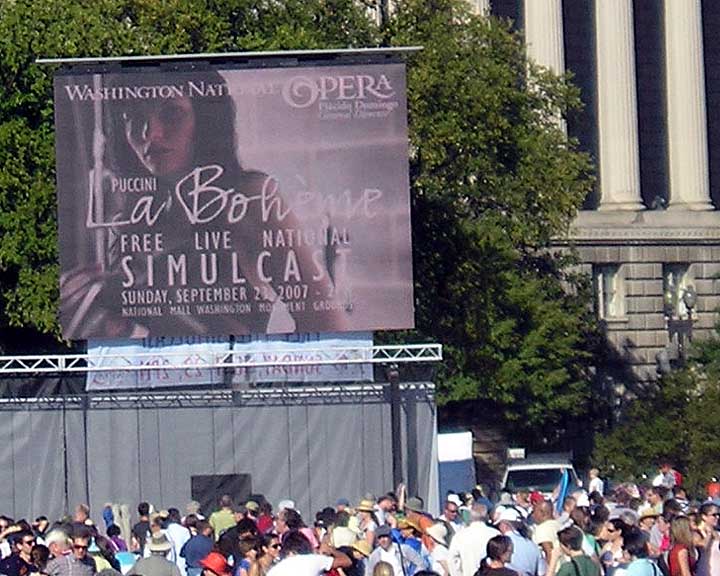
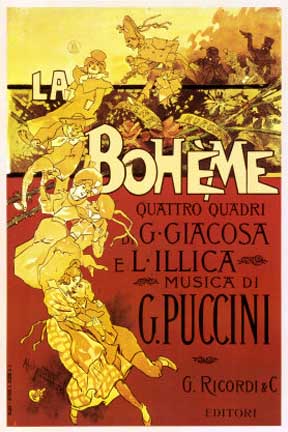 Who wants to go to the opera with me? It's free!
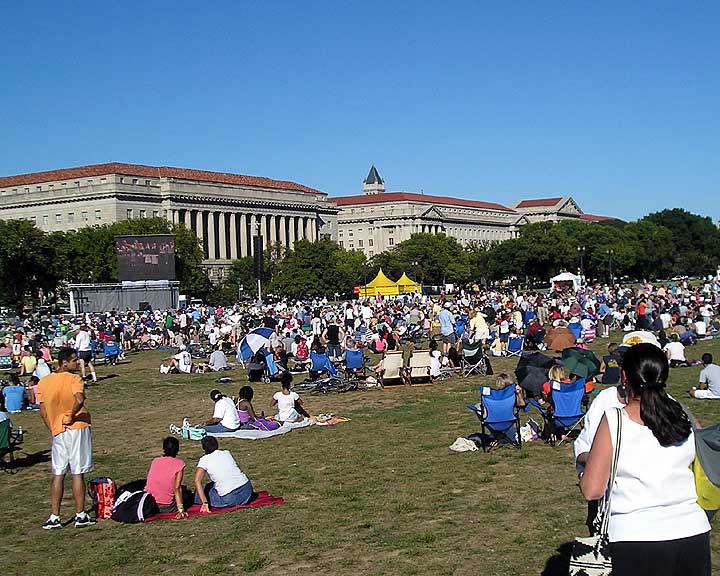
Washington National Opera is doing their annual outdoor live simulcast on the National Mall (plus adding theaters at universities all over the country) this Sunday afternoon. This year's offering is Giacomo Puccini's La Bohème, one of the beloved "war horses" of the opera repertoire and the inspiration for the popular musical and movie Rent.
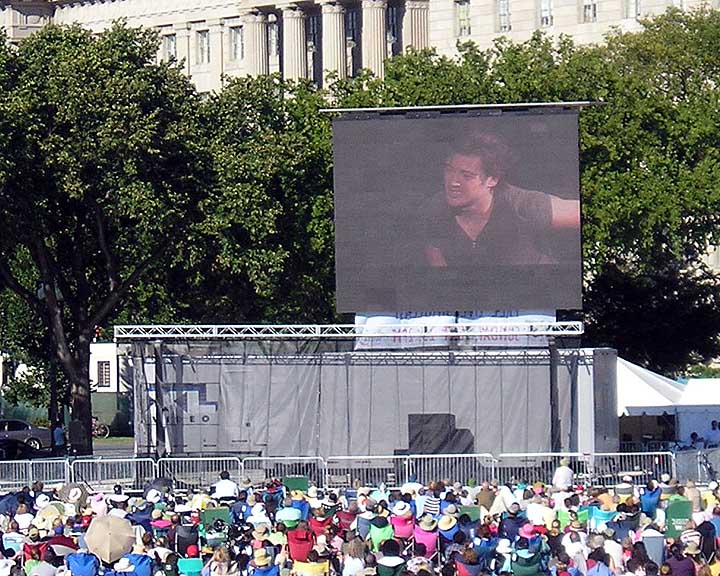
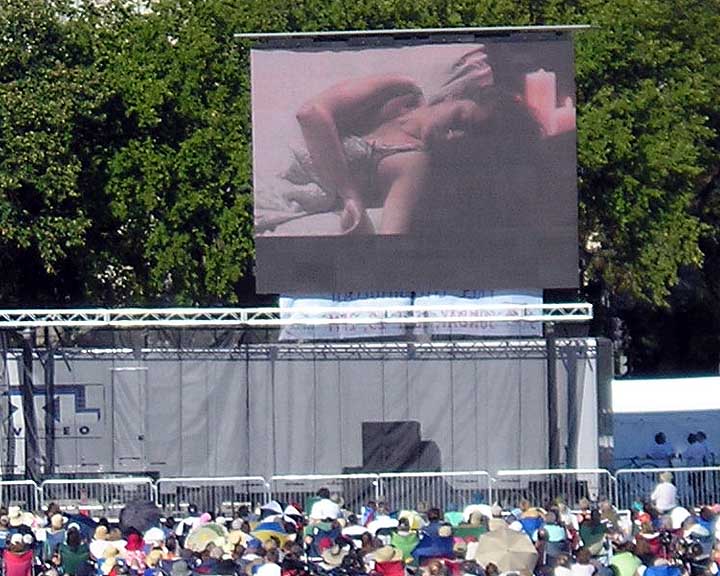
The outdoor opera broadcasts (on a huge, billboard-sized Jumbotron screen) started two years ago with the highly successful Porgy and Bess, followed last year by an unfortunately rainy Madama Butterfly. This year, though, the weather forecast for Sunday afternoon is a beautiful, sunny day with temperatures in the low 80s.
So, Ryan and I are going, and we'd like to get a few people together and organize a little picnic lunch we all can eat on the ground at the Mall during the show. It'll be lots of fun! Will there be gourmet home-cooked foods? Or will be be dining on fried chicken from the Safeway deli? Who's interested? Let me know so we can get this all planned out.
"Curtain" time for the opera is 2 p.m., so we should plan to be at the Mall by at least 1 p.m. While the opera is sung in Italian, there will be English translations on the screen as subtitles.
This should be a particularly interesting production. The opera originally is set in the 19th century with the bohemian artists of Paris, but Washington National Opera has elected to "update" the production to the modern day. I understand there's a La Cage a Folle-type production number (no doubt at the Cafe Momus) and there are video montages of Mimi and Musetta. It will either be wonderful or a total abomination! Let's go see!
 For those of you not in the D.C. metro area, there are a number of colleges showing the simulcast as well. More details are on WNO's Web site, but I think the schools are: Brown, Bryn Mawr, Cumberland School of Law, Duke, New York University, North Carolina School of the Arts, Ohio University, Princeton, Rice, Southern Virginia Higher Education Center, Temple, Tulane, Union College, U. S. Military Academy, Virginia Tech, Wellesley, and the Universities of Alabama, Arkansas, Colorado, Florida, Massachusetts–Amherst, North Carolina, Oklahoma, Richmond, Virginia and Washington.
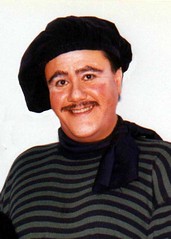
Here's a pic of me the last time I sang in a Bohème production (no, I'm not singing in this one, and, unfortunately, I don't know any of the cast of this show). My makeup designer asked me to grow a moustache for the production, so I did that for nearly three months, and he still had to color it in with an eyebrow pencil!
Thursday, September 20, 2007
New theater

Last Saturday we went to the open house for the new Harmon Center for the Arts downtown across from the Verizon Center. The Harmon Center is the new second venue for the Shakespeare Theater Company. The company will continue to operate its original theater a block or two away, so they'll have two places for shows. The old theater holds about 450 and the new theater seats about 750.
The new facility is an office building that's been gutted and completely redone to include the new theater, performance space, concessions, patrons' lounge, box office, office space, and gift shop. The upper floors of the building are traditional office space for outside entities. The architectural design opened the building facade to the street and added a series of cantilevered floors that create more space overhanging the sidewalk, then enclosed it with a glass wall so the entire three floors of the theater lobby will be visible to the street.
I took a few photos inside the new theater, but as they were having a constant series of free performances during the day, flash was prohibited, so you'll have to deal with a little bit of blurriness from me trying to hold the camera still in a dark auditorium.
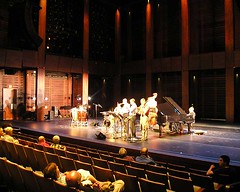
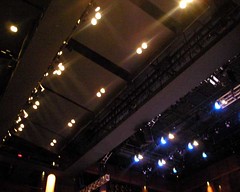
Above is a photo of the stage. It's rather open with no proscenium or curtain—part of the unfortunate modern trend in theater design to eliminate the "distance" between the action and the audience in an attempt to make live theater more "relevant" (whatever that means). In the second photo, you can see the fly space, which really isn't a fly space, as the lights and things are just hanging there out in the open.
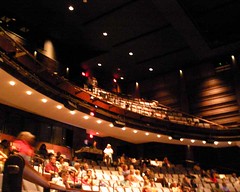
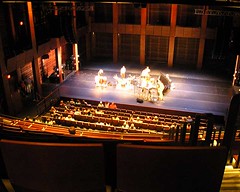
Next is a view of the house. The lower level actually has two levels, but I was standing on the side about midway, so you can see the lower seats, which are on a flatter floor. The balcony up above is quite steeply banked; you can see that in the second photo, taken from the back row of the balcony. The view of the stage from the balcony is actually quite good.
Brian was very excited about the new theater facility, since he is considering applying for a year long internship with the company for after he finishes his technical theater degree at Dartmouth next June.
Subscribe to:
Posts (Atom)
